Blog: Adrenaline Reflection
The Adrenaline Film Project is a three-day intensive filmmaking workshop held in Eugene, Oregon as a part of the Cinema Pacific Film Festival. Every year, twelve teams of three filmmakers embark on a journey fueled by their passion for film, mass amounts of caffeine, and frankly, adrenaline. Since learning about the Adrenaline Film Project two years ago, I have only participated on the sidelines of these projects (Redbull runner, child wrangler, on-set cheerleader). Until this year.
With my usual film partner employed by Cinema Pacific as a videographer, rendering him ineligible to enter as an Adrenaline team member, I assumed this would be another year of sidelines. A week before applications were due, I met Michael Schmidt, a producer of the original Duck TV sketch comedy “Fifth Year.” After chatting film over a homemade meal of pasta (and a few beers), the decision was made: we would apply for Adrenaline.
Our third team member and director, Monica DeLeon, had wowed the audience at last year’s Adrenaline screening with her B-movie genre film “The Rat King,” and had worked with me in the past on various projects (we are also currently working together on a documentary following a local Eugene artist, “Dan Chen: in Retrospect”). And she was obviously our best option behind the camera.
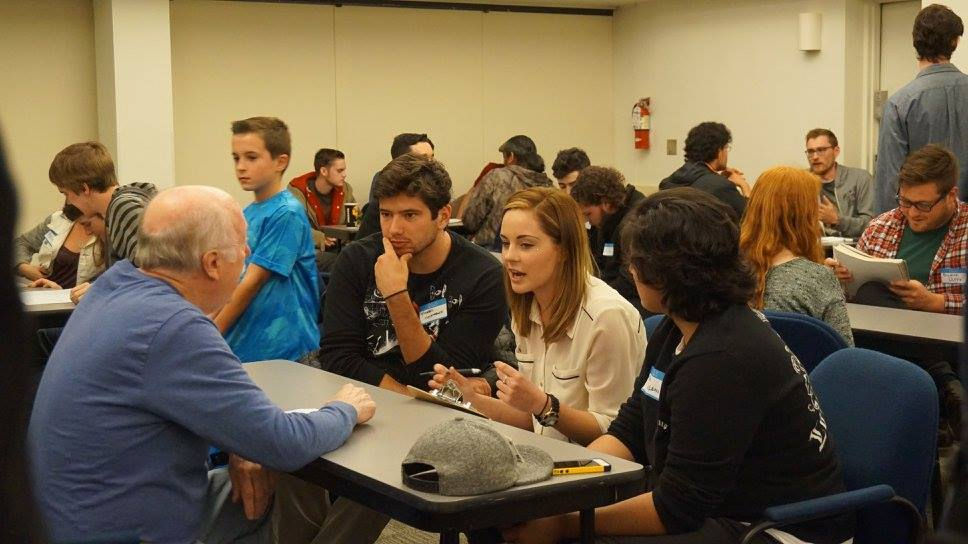
The Adrenaline Film Project is also accompanied and supervised every year by three film mentors. This year, we were lucky enough to work with Jeff Wadlow, writer and director of Kickass 2 and co-creator of Adrenaline, Hollywood acting coach Leigh Kilton-Smith, and Lebanese director and screenwriter, Omar Niam.
After being accepted to the project, my drive became focused on one thing: to prove that I am not just a friend/daughter/girlfriend of great storytellers. That I can run a production without someone looking over my shoulder, holding my hand. Don’t get me wrong, I could never do this kind of thing alone, and I am forever grateful for my other team members.
We were assigned the genre “gangster” and were given a throwing star prop and the line of dialogue “It’s about balance” to incorporate into our five minute film. Ultimately, my sideline experience paid off. The production of “Dirty Deeds” was the smoothest I have ever been a part of. We were able to cast two incredible local Eugene actors, T. Sean Prescott and Tom Wilson, as our gangsters. We had the help and support of so many friends, old and new, especially our videographers, Garrett Guinn and Nick Borges-Silva, and our makeup artist, Erin Brandsness.
Our film followed the main character, a gangster henchman with extreme OCD (who we deemed “Mr. Clean”) going through the motions of his job in his own particular extra-neat way. He meets with his Boss, who informs Mr. Clean that he has received a threat, and that he’s like it taken care of. Here’s the catch: The Boss wants to sit in on this one, which is not congruent with Mr. Clean’s system and is, ultimately, his final tragic mistake.

In the end, “Dirty Deeds” was awarded Honorable Mentions in both the Audience and the Jury categories, which felt great but was not my greatest achievement of the weekend. I entered into the project with a competitive mindset; I wanted to make the best film, I wanted to incorporate the prop and the line of dialogue better than anyone else, I wanted to impress the mentors. After three days of mind-bending dedication simply to the art of film, sitting in the editing room I felt closer with the thirty-six other filmmakers surrounding me than friends I have had for years. I became friends with members from other teams regardless of the competition and by the end I believe we all truly wanted to see every team produce a great film. When “Dirty Deeds” was announced runner up to the surreal genre film “Clark” (produced by Joe Glasgow, Jacob Salzberg, Michael McGovern, and Bryan Kalbroski), I felt nothing but pride in my new friends.
If I have learned one thing, it’s that I am done hanging on the sidelines. I am a writer first but that doesn’t mean that I am chained the rollercoaster depression that is literary publishing. With the resources I now have, and the team of filmmakers that has formed around me, there is no story we cannot tell.


Comments